Ontdek de collectie
Kunstmuseum Den Haag has a treasure chamber of over 160.000 pieces of art. Here we work on making the highlights from this collection available online.
Marlow Moss
A Suitcase Full of Sketches

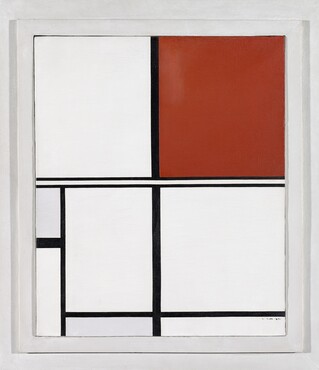
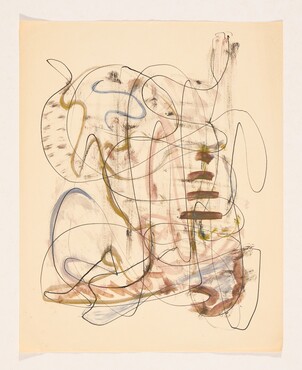
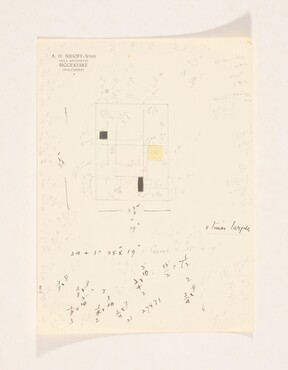
Kunstmuseum Den Haag recently acquired a suitcase containing more than a hundred preliminary studies by the artist Marlow Moss (1889-1958). From 13 December, the museum presents a selection of these sketches alongside three paintings by Moss from the museum’s collection that are being reunited after several years of travelling to exhibitions in the Netherlands and abroad. Like other geometric abstract artists of her generation, Moss sought a perfect harmony of lines and planes, creating a reality removed from the material world.
Moss made the sketches, which all date from after 1940, as studies for reliefs, sculptures, paintings and drawings. They demonstrate the artist’s versatility, including mathematically calculated compositions, watercolours with organic forms and preliminary studies for pencil drawings.
At the heart of the art world
Moss was at the centre of avant-garde art circles in the 1930s and in close contact with other artists. For this reason, the display includes works by her contemporaries such as her artist friend Jean Gorin, who adopted a similar mathematical approach in his work. Piet Mondrian was also an important contact. Moss and Mondrian admired each other’s work, and Moss has been credited with introducing the double parallel line also adopted by Mondrian.
Extraordinary life
Marjorie Jewel Moss was born in 1889 in London, where she studied at the Slade School of Fine Art and the Académie Moderne. After studying at art academies in London, she left for Cornwall in 1919 to focus on art and literature. Shortly hereafter, in 1921, she cut her hair short and adopted the gender-neutral name Marlow. At the end of the 1920s, she relocated to Paris, where she encountered Mondrian and became an integral part of the city’s artistic life. There she met the Dutch writer Netty Nijhoff, who became her life partner. Together they split their time between Paris, Normandy and Zeeland. In 1940 Moss, who was of Jewish ancestry, had fled to Cornwall, where she lived and worked until her death in 1958. Because of Moss’s connection with the Netherlands, today many of her works are in Dutch museum collections, including three paintings in the Kunstmuseum Den Haag.